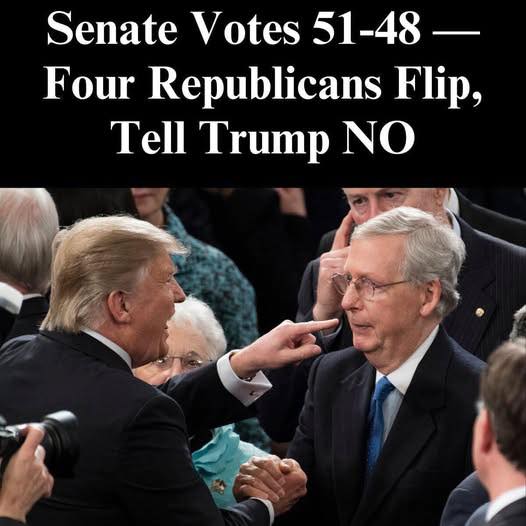
On a crisp spring day in early April 2025, the United States Senate delivered a striking rebuke to President Donald Trump’s aggressive trade agenda. By a vote of 51–48, lawmakers approved a resolution disapproving Trump’s plan to impose at least 10 percent tariffs on nearly all goods imported from Canada. What made the outcome especially remarkable was that four Republican senators—Rand Paul (R–Ky.), Susan Collins (R–Maine), Mitch McConnell (R–Ky.), and Lisa Murkowski (R–Alaska)—crossed party lines to side with the Democratic minority. Their votes underscored deep fissures within the GOP and sent a clear message: even in a Republican-controlled Senate, the administration’s broad use of emergency trade powers would not go unchallenged.

This article explores the legal framework behind the tariffs, the Congressional Review Act mechanism used to overturn them, the floor debate and behind‑the‑scenes maneuvering, and the broader economic and political implications of this unusual bipartisan alliance.
The Road to Conflict: Section 232 and the National Emergency Declaration
President Trump’s decision to levy tariffs on Canadian imports traces back to his broader “America First” trade philosophy. On February 13, he invoked Section 232 of the Trade Expansion Act of 1962, a seldom‑used provision that allows the president to impose trade restrictions on national security grounds. Citing concerns about the United States’ reliance on foreign steel and aluminum—and, more pointedly, Canada’s status as the country’s largest trading partner—Trump declared a national emergency and announced 10 percent duties on steel and aluminum, and 25 percent tariffs on all other Canadian‐made goods when the emergency was renewed in March.
The White House rationale framed the move as a necessary step to protect American manufacturing and reduce the bilateral trade deficit—more than $20 billion in 2024—even though analysts noted that Canada’s exports to the U.S. largely complement rather than compete with domestic production. Moreover, the administration’s broad interpretation of “national security” sparked immediate international pushback: Canada threatened proportional retaliation, the Mexican peso slipped, and U.S. industries that rely on Canadian parts—automakers, construction firms, aerospace manufacturers—warned of sharply higher costs and supply‐chain disruptions.
The Congressional Review Act: A Tool for Overturning Executive Actions
Facing mounting industry outcry and diplomatic fallout, Senate Democrats seized upon the Congressional Review Act (CRA)—a 1996 law designed to allow lawmakers to overturn recently issued federal rules. Under the CRA, both chambers of Congress can pass a joint resolution of disapproval for any “major rule” within 60 legislative days of its publication, and the president must sign it or see it vetoed. While traditionally used sparingly—and almost exclusively against regulations enacted by the opposing party—this week’s resolution targeted a presidential proclamation rather than an executive agency rule, testing the CRA’s scope.
Given the GOP’s razor‑thin majority (51–49 in the Senate), Democrats needed at least four Republican votes to succeed. It was a high‑stakes gambit—if the resolution passed the Senate but failed in the GOP‑led House, it would amount to a largely symbolic gesture. But if it cleared both chambers and survived a presidential veto (a near‑impossible feat with Trump in office), it would strip the White House of its ability to enforce the tariffs.
The Senate Stage: Debate, Speeches, and Surprises
April 9, 2025, opened with floor speeches that quickly revealed the depth of concern across party lines.
-
Sen. Ron Wyden (D–Ore.), lead sponsor of the resolution, framed the vote as a defense of American consumers and allies: “We cannot weaponize emergency powers to burden our neighbors and punish our own businesses. This is an assault on good trade policy—on the regionally integrated supply chains that sustain jobs in Detroit, Salt Lake City, and beyond.”
-
Sen. John Thune (R–S.D.), chair of the Commerce Committee, lamented the administration’s unilateral approach: “We live in a global economy. Tariffs are taxes on U.S. consumers and manufacturers. I don’t oppose strong borders, but using the national security card in this context is misguided.”
By contrast, supporters of the tariffs took the floor to defend Trump’s move as bold and necessary:
-
Sen. Josh Hawley (R–Mo.) argued, “We have surrendered our steel industrial base to China and others. If trade partners won’t play fair, we must act.”
-
Sen. Tommy Tuberville (R–Ala.) echoed the theme, citing plant closures: “When your hometown mill shuts down, that’s security at risk—security of our economy and our communities.”
The vote tally remained in flux until late into the late afternoon. In a display of personal courage, Sen. Rand Paul, a longstanding free‑trade advocate, announced his support for the resolution: “I cannot sit by as our president stretches emergency powers to tax everyday Americans. I stand with economic liberty.” Moments later, Sen. Susan Collins of Maine—a key steel and paper producer state—followed suit, emphasizing the burden on small businesses.
Then came the surprise of the day: Senate Minority Leader Mitch McConnell, who rarely defies his own party leadership on procedural votes, rose to declare, “I believe the president has overreached. Our Founders did not intend the emergency powers clause to sanction sweeping tariffs that could trigger a global trade war.” Within minutes, Sen. Lisa Murkowski of Alaska, citing concerns for her state’s seafood exports, added her name to the “yes” side, sealing the resolution’s fate.